The Vaisnavite State’s Shaivite Anthem
This might come off as pretty random of a piece, but much rather— it is of a song I came across during my research for a longer blog piece on the Ranis of Attingal: something coming soon (This is certainly not an excuse to cover for me not having posted anything for a month).
As a person who has had a fairly recent fling—if I may call it that—for his interest in listening to Carnatic music, this was an audio link I randomly found yesterday—something that got me somewhat nostalgically hooked while listening—on a random website during my research.
The title of it being, “Vanchi Bhoomi” — The Land of the Vanchi:
A simple search for an English translation of this composition exposed me to an interesting set of historical documents — mere puzzle pieces I started digging into, only to find more puzzle pieces. My research included everything from contemporary research papers to archive.org documents from the 1920s. This shall be a fairly concise version of all that research — an attempt to put those puzzle pieces I found all together:
Sundara Murti Nayanar — one of the 63 revered Tamil Shaiva saints — unwavering in his devotion to Lord Shiva, prayed to be taken to Kailasa: The divine abode of his Lord. It was when Shiva was pleased with Nayannar’s devotion that he dispatched the sacred, white, divine elephant—Airavata—to bring Nayannar to heaven. It was behind him that the great Chera king Cheraman Perumal pursued on his horse as he chanted a mantra into the horse’s ears. Eventually, both of them would transcend the bonds with the Earth and soar to the abode.
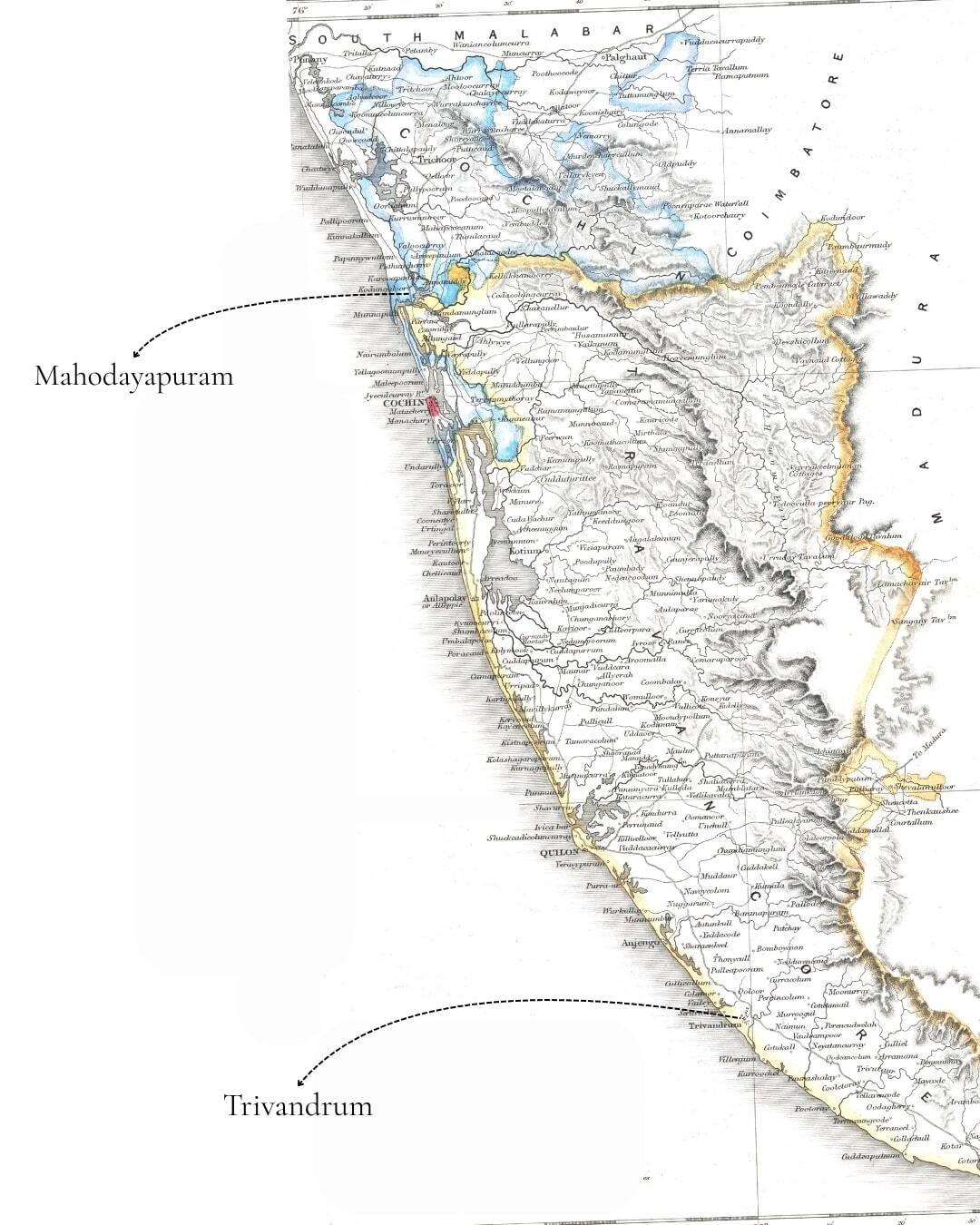
It was to commemorate this legend that the later Cheras built a temple right across their palace at “Vanchi” — The capital for their ancient kingdom — at the supposed place where Nayanar prayed day and night to his lord. This was the city of Mahodayapuram. — now about 40 kilometres North of the bustling city of Kochi, in the outskirts of a small town called Kodungallur — the city that would go on to give the Cholas their most powerful of queens: Including Kokkilan Adigal, Queen to Parantaka Chola I—the Conqueror of Lanka and Madurai.
This now not-so-famous temple’s deity—Vanchinathan, Shiva as the Lord of the Vanchi—was once the great tutelary deity of the Cheras. This shrine would come to be the only one in the entirety of what is now Kerala, to be mentioned in ancient Tamil Sangam literature and the Thevaram hymns.
Centuries after the time of the Cheras, in the 1700s—at a time when the Dutch had started stepping into India’s western coast—would come the great king: Marthandavarma of Travancore. The man, who through his bloody rampages would consolidate the balcanised region into his Travancore — much to the South of the area the Cheras had ruled over. The same man who would, after all this, surrender himself, and his whole kingdom, to the deity he so loved: The Lord Padmanabha, at the great temple in Trivandrum. Every ruler of Travancore after this would come to be known by the title of ‘Padmanabha dasa’ — the servant of the Lord. Travancore would unquestionably become a Hindu state with its principal deity being the “Padmanabha” form of Vishnu.
Besides all this, during the 1930s—about 170 years after Marthandavarma—came a commission that was made to the then Court Poet, and the Chief Secretary at the court of Travancore—Ulloor S. Parameswara Iyer—to compose the first ever anthem for the Travancore state. His genius would give Travancore this very piece that you heard: a Shivite anthem for the Vaishnavite Deity’s Kingdom—an anthem that would come to be largely forgotten after the state’s accession into India.
The great anthem would come to become the formal closing piece for the Travancore Radio for another 20 years, being sung in all royal gatherings and ceremonies thereafter.
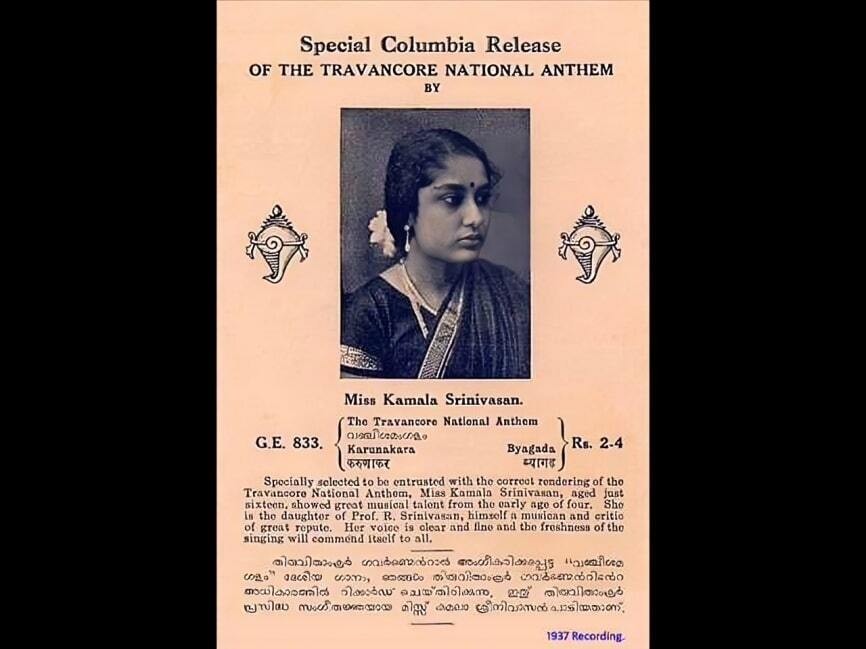
The anthem would soon die, with the consolidation of the “Hindoo Princely State of Travancore” into the Indian Union, solely leaving a piece for adaptation by Carnatic singers and a few in Malayali cinema. But the question still persists — why did the state with a principal Vaishnavite deity have a Shivite anthem, dedicated to a deity and a temple much beyond the boundaries of the state itself? Well, unfortunately, the answer is not very comprehensive or satisfactory (atleast out of what I found).
One additional piece of information that links Travancore to the Cheras is the title held by the Travancore king himself. The full regnal name was as follows:
“Sree Padmanabhadasa Vanchi Paala [Personal Name] Varma Kulasekhara Perumal”
The title is indeed very interesting for 2 specific reasons: The reference of “Kulasekhara” which is a direct reference to the claim of the Travancore king to their supposed Chera heritage for it was the name held by the Later Cheras; and the additional title as the “Vanchi Paala”, the protoector of Vanchi—linking the title directly to the ancient Chera capital.
For further historical understanding, a deep dive into Medieval history is a must. Most of what is now southern Kerala was ruled by the Ay dynasty until the medieval period. After the collapse of the Later Cheras around 1124 CE—in central Kerala—remnants of the Chera royal house moved south. Rama Kulasekhara, the last Chera king, established his capital at Kollam around 1100-1122 CE. One branch of the Chera family is said to have been sent south to deal with Pandyan invasions and merged with the Ay kingdom. This created the “Chera-Ay dynasty” that ruled “Venad” from the 12th century onwards. This dynasty hosted famous rulers including Sangramadhira Ravivarman Kulasekhara (1266-1314) — the man who raided the Cholas and the Pandyas, and then crowned himself as “Tribhuvana Chakravarti” (ruler of three kingdoms: Chera, Chola, and Pandya) at Kanchipuram in 1312; and the man from whom the title of “Padmanabhadasa” is believed to have originated from—much before the reign of Marthanda Varma.
When Marthanda Varma assumed control of Travancore through his bloody campaigns in the 1700s, he had started to make an attempt to legitimise his authority in the kingdom. This process, as mentioned before, included the move of surrendering the kingdom the the Lord, identifying himself to be a mere servant of god—as a consequence any criticism of the king would be an attack on Lord Padmanabha himself.
Further, when Marthanda Varma performed the Hiranyagharbha ritual—a process usually used to elevate one’s Varna—in the process of ceremonially crowning himself as the legitimate king, he is said to have claimed the “Chera Mudi” (Chera crown) during the ceremony: hence adopting the title of “Kulasekhara Perumal” formally as part of his title, a title that the royalty of Travancore would use to harken back to their Chera heritage. This is probably a link to why the Travancore royals commissioned the anthem as a link to their Chera heritage — probably again a move for political legitimacy?
This is in no way a complete piece. The history of this goes beyond much of the information that you can find in the internet. Any further research, as I realised, is in the political correspondence of the 1920s, including letters, speeches, among other things. The complete picture is something that will certainly require answers to the following (leaving this here, so that I can go search for more):
- Why was the anthem commissioned in the first place—was it solely to keep up with the “trend” of all princely states having their own anthem, or were there other reasons that led to the need arising?
- How was the anthem commissioned to Ulloor? — Any correspondence between Ulloor and the Royals about any specifications?
- What symbols of Chera heritage did the Travancore Royal family flaunt other than the anthem itself? — for this wouldn’t be the sole symbol of legitimising Travancore’s heritage from the Cheras
- The entire story of the consolidation of Travancore — Marthanda Varma’s story: what were his actions to legitimise his kingdom to be Chera? —actions that would come to have ramifications on Travancore rulers centuries after him, hence leading to the anthem’s commissioning
That’s pretty much where this piece ends. It all started with tracing the story of a song that has sort of become folk at this point—ultimately leading me to the story of the Cheras, the Ays, and Marthanda Varma, his campaigns, and his strategy for political legitimisation. A follow-up is certainly called for—it is something I will get back to when I have the necessary information.
Hope you liked this one :)