<?xml version="1.0" encoding="utf-8"?><feed xmlns="http://www.w3.org/2005/Atom" ><generator uri="https://jekyllrb.com/" version="3.10.0">Jekyll</generator><link href="https://eshwarra.github.io/feed.xml" rel="self" type="application/atom+xml" /><link href="https://eshwarra.github.io/" rel="alternate" type="text/html" /><updated>2025-09-29T04:14:30+00:00</updated><id>https://eshwarra.github.io/feed.xml</id><title type="html">Eshwar’s Blog</title><subtitle>A blog about history, polity, and tech - my opinions</subtitle><author><name>Eshwar R A</name></author><entry><title type="html">Hinduism, Hindu“tva” and Dharma: Part I</title><link href="https://eshwarra.github.io/blog/personal/Thoughts-on-Hinduism/" rel="alternate" type="text/html" title="Hinduism, Hindu“tva” and Dharma: Part I" /><published>2025-09-28T00:00:00+00:00</published><updated>2025-09-28T00:00:00+00:00</updated><id>https://eshwarra.github.io/blog/personal/Thoughts-on-Hinduism</id><content type="html" xml:base="https://eshwarra.github.io/blog/personal/Thoughts-on-Hinduism/"><![CDATA[<p>I will start this—what is going to be a fairly long—set of blogs with the customary “I don’t care if people read this; The purpose of this blog piece is just an archiving of my personal thoughts, learnings and opinions” remark. I mean that more than ever, for these blogs are an encapsulation—if not a culmination (for the learnings are a continuing exercise)—of all I have learnt over the better half of 2 years of reading on different aspects of this subject. Barring all the childhood stories and hymns I might have learnt from my mom—and other people “here and there”—it was only for the past 2 years that I took a concerted effort to sit and read on it academically. The infatuation mostly started with an understanding of how political Hindutva looks: the history of the Hindutva movement for most of the colonial period. Simultaneously, through participating in MUNs, I was prompted to read on subjects like the Waqf Act and the POWA (something I will detail in this blog(s)). It was in this timeline that I went through a huge learning curve: a lot of books, lectures, and podcasts later, I am starting to see a complete picture of this entire discussion—being hence in a position to have my own opinion on several of these subjects: opinions I wish to preserve somewhere.</p>

<p>The blogs are going to be a rather vast set of seemingly random amalgamation of several political, theological, philosophical, and historical subjects. The goal is not to give you a piece of research—although a lot of “research” has gone into writing this vast piece—but instead to lay down my opinions on a lot of these subjects. Personally, this is just an effort of putting my opinions down for my own good somewhere so that they don’t disappear from my head one day (likely to happen given placements season starting soon). 
I hope you guys like it :)</p>

<hr />

<h1 id="defining-hinduism">Defining Hinduism</h1>
<p>The general notion of “Hinduism is not a religion, but instead a way of life” comes from the 1966 Sastri Yagnapurushadji case and was reaffirmed in a 2023 judgment. Using this argument beyond the scope of the case for which the judgment was given is mischievous and has often led to wrong conclusions. Hence, for the rest of this section, I will try to define what Hinduism is: While it is easy for people in popular discourse to tell you what it is not, I will try telling you what it is—the core that makes it.</p>

<p>Hinduism tends to be a fairly fuzzier concept than Abrahamic conceptions. The idea—that I hold is that—Hinduism is certainly nothing but a “religion”: just that it is much different from a Western conception of what religion entails.</p>

<p>The reason I would consider Hinduism to be a religion is as follows: just like other religions, it too contemplates the place that a person holds in this universe; dwells on ethics, rituals, traditions, among other things.</p>

<p>Where Hinduism would certainly differ in its core from other “religions” is the idea of pluralism (a theory or system that recognises more than one ultimate principle—or in this context, one that recognises the presence of multiple faith systems, and respects it). The Abrahamic conception of religion rests on the idea of you having to believe in a set of axioms to be part of that religion: for example, to be a Muslim, you would have to believe that Mohammed was the last messenger of god, and that there is only one god, among a set of other things. Again, of course, there are other nuances to the interpretation of what these religions entail (for example, the several sects that exist as part of Islam in this context). But regardless of the sect, there is no denying that there is a uniform set of these axioms that must be accepted—across all sects—for they represent the core identity of the religion: making it a “monoist”ic ideology at its core. The same explanation can be applied to other Abrahamic religions as well.</p>

<p>Hinduism, however, is different: for it does not have any set of starting axioms, i.e. there is nothing that defines who is a Hindu. You can be a polytheist, a monotheist, or an atheist or a combination of any of these, or even have an entirely new belief: all this and still be a Hindu.</p>

<p>The immediate question then would be to ask “What are the boundary conditions?” (the quintessential engineer’s question), i.e. what brings unity in all of your beliefs to call it one unit—”Hinduism”. I will answer this vaguely right now, but just stick with me till the end for you will get a much clearer picture!</p>

<p>What brings Hinduism together is all about the questions it asks, the processes of inquiry, idioms, all the texts bring together in order to allow for a framework of conversation, various rituals and festivals changed among a multitude of other things: it allows for plurality, scepticism, preference for liberty and openness (We shall come back to this idea).</p>

<p>To start to better understand that very question, let us start by understanding the architecture of Hinduism.</p>

<h2 id="the-architecture">The Architecture</h2>
<p>Hinduism has no set number of religious texts: history tells us that texts have emerged for millennia. For example, the Skanda Purana had several portions of it which came into existence after the 1200s, while you have the Vedas themselves, dated to about somewhere between 1500 and 2000 BC.
Texts in Hinduism—among other ways of classification—can be distinguished into the following two sets:</p>
<ol>
  <li>The Shruti</li>
  <li>The Smriti</li>
</ol>

<p>Going by the strict definition, the Shruti stands for that which is divinely inspired or heard, while the Smriti refers to that which is remembered—the great thoughts.</p>

<p>In our context, this definition would mean that the Shruti texts are the only true canonical texts of Hinduism: the true word of god, while the Smriti texts are literally any other Hindu text out there.</p>

<p>The Ramayana and the Bhagavat Gita would be considered by most naive ones to be the “great sacred texts of Hinduism”. Rishi Sunak, too, for example, when taking his oath as the British Prime Minister, swore on the Gita, not any other Hindu religious text. Hence, going by sheer popularity, one would consider the Gita or Ramayana to be the “Shruti”.</p>

<p>But, in reality, Hinduism—strictly speaking—has only 3 canonical texts: the first three Vedas, i.e. the Rig, Sama and Yajur Vedas. These three—in broad conception—make up the authoritative/primary texts of Hinduism. The Ramayana, Mahabharata, and pretty much any other religious text you can think of is a Smriti: non-canonical, and “non-binding”—in lawyer language.</p>

<p>For example, the much-hated Manusmriti too is a Smriti text. The Manusmriti is one of the many Dharmaśāstras of Hinduism that discusses an array of topics: including the duties, rights, laws, conduct, and virtues. However, several condemned the prescriptions of the Manusmriti, including Dr B. R. Ambedkar, who famously burned copies of the Manusmriti in 1927 to protest its influence on caste discrimination, reasoning that it was a foundation for caste oppression. For all the hate it receives, the religion in no way enforces it on its followers. Scholars doubt whether the text was ever enforced in Ancient or Medieval times by any rulers. The first known enforcers of the text were actually the British, who used it as one of the canonical texts of Hinduism when codifying “Hindu Law”. The Smriti texts, as I said earlier, are non-binding i.e. it is not compulsory for a hindu to follow it: yet they were codified by the British as “Hindu Law”, reducing centuries of vigorous development of total ethical, religious and social systems to fit their own preconceived European notions of what Hindu “law” should be: and then enforcing it on the very same people. This codification of “Hindu Law”—which, by the way, is still followed in Indian law—reduced an organic, living and ever-evolving system to what a 3rd-century text says: retarding the entire dynamical system of the practice changing over time.</p>

<p>Coming back to the Smriti texts, as a whole—they are by definition non-enforceable on anyone. You can literally write your own text if you disagree with any of them.</p>

<p>To put it in simpler terms, Shruti is like a bookshelf, and the Smritis are like the books themselves. You can add, remove, and hence constantly keep changing the bookshelf: This entire ecosystem is what forms Hinduism.</p>

<p>Now, let me play the devil’s advocate for a bit—here is the question that is posed: How can Hinduism be called a “plural” and “all accepting” ideology when you are literally saying that the Vedas are the core? For example, Muslims too believe in the Holy Quran (it can be called a Smriti in this context), while Fatwas are issued constantly across the world as interpretations of the Quran and Islamic law in general (So in this context, I can call the Fatwas the Shruti—constantly open to change). Or in other words, how is Hinduism any more plural than an Abrahamic religion per se when it too relies on the Shruti texts as the base.</p>

<p>The answer is 2 fold (and a little complex):</p>
<ol>
  <li>You do not have to exactly accept the Vedas for their word to be a Hindu. The reason I call them canonical is that most ideas in Hinduism can be traced back to these 3 Vedas: historically and philosophically (and in terms of a lot of deities we worship). The Vedas are not in any way binding on any future texts that come: you can oppose the Vedas and still be a Hindu. For example, the Veera Shaiva movement fundamentally rejected Vedic authority, yet it was still considered to be part of the Hindu umbrella, as a Nastika tradition (a non-Vedic tradition).</li>
  <li>The Shruti texts themselves are fundamentally plural (More on this in the next section)</li>
</ol>

<h2 id="the-origin-of-the-shruti-texts-the-rig-veda">The Origin of the Shruti Texts: The Rig Veda</h2>
<p>The Rig Veda itself is a Bronze Age text—written somewhere between 1500 and 2000 BC. The tribe was led by a king named Sudasa, and his guru—Vasishta, who defeated 10 tribes to the east, on the banks of the river Ravi, and another few to the east: on the banks of the Yamuna. They arguably created the first known Indian empire in the early Vedic period.</p>

<p>Interestingly, after defeating these 10 tribes, they did not attempt to declare the supremacy of their god(s) on the rest—instead, they brought together the sages of all these tribes that they had defeated too: to compile the best ideas of the time. This gave us what we now know as the Rig Veda. The Rig Veda was not the beginning of the ideas of a civilisation; it was the mere compilation, hence culmination of a lot of existing ideas.</p>

<p>The infamous Gayatri Mantra—one of the most popular Hindu Mantras—was composed by Vishwamitra as part of the Rig Veda: a Rishi from one of the 10 defeated tribes.</p>

<p>Further, our history textbooks tell us of how “Indira and Agni were ancient Vedic gods. Vishnu and Shiva are later gods”. This is a mischievous attempt, for the deity “Vishnu” appears in the Rigveda, mentioned 93 times across various hymns. The statement is rather vague, leading you to misconstrue that Vishnu and Shiva did not exist in early Vedic times—they certainly did. Maybe they were not as significant as Agni, or Indra—but they did exist.</p>

<h2 id="the-norm-of-the-time">The Norm of the Time</h2>
<p>Notwithstanding how long before the Vedas did Hinduism, and Hindu gods exist—it is safe to acknowledge the presence of several other civilizational faith systems that existed across the world: Taoism, the Ancient Egyptian, Mesopotamian, and Greek religions, among others.</p>

<p>For many of these faith systems preceded this form of codified Vedic religion, it is completely possible that there was some form of confluence of ideas between these different civilisations. Much of this confluence gives us a similarity we see in ritual and the deities worshipped across these different civilisations.</p>

<p>For example, take the Egyptian deity Anubis: associated with the colour black, dog-faced, and known as the deity for funerary rites, also the protector of the graves, and the guide to the underworld. Hinduism has a deity of a similar kind, too: Bhairava. Bhairava’s vahana (the animal associated with the deity) is a dog; Also associated with the colour black. Bhairava is a cremation ground deity, worshipped as the kshetrapala (the guardian of the area).</p>

<p>These similarities are not isolated to any one Hindu deity—for it is evident that there was some form of synchretization where deities/rituals/several aspects were borrowed from one culture to another. Hence it is completely possible for Hinduism to have borrowed deities from the outside, or even for similar deities to have parallely come about in different cultures for metaphysical reasons we do not understand.</p>

<p>Hence, Hinduism’s plural values were not unique to its time—pluralism was the norm of the time of Hinduism’s development, along with an evident borrowing of ideas that possibly occurred across various faith systems of the then world, if not for an indigenous parallel development. The existence of plural faith systems preceded the Vedic religion across the world: Hinduism was probably not the first. However, the reason for the stark difference of pluralistic values comes from the mere fact that Hinduism is the sole surviving one of these ancient systems—as opposed to the rather newer Abrahamic, monotheistic idea of faith.</p>

<h2 id="boundary-conditions">Boundary Conditions</h2>
<p>My broad thesis for all I have said until now is how Hinduism, at its core, respects pluralism. To put it into perspective, let me reiterate it as follows—the plural nature of Hinduism is reflected at 2 fronts:</p>
<ol>
  <li>At its core: Wherein the formation of the vedas itself were a plural exercise of these different tribes—who ultimately got their gods all together into one piece of literature. Hence, it all starts of with the fundamental text itself respecting all different practices and ideas across the different tribes, and their different gods: the epitome of plural values.</li>
  <li>Beyond the core: Neither the Shruti, nor the Smriti texts are binding on any follower—you can selectively agree with one or more texts, have your own interpretation, or even discard the Vedas themselves in your ideology: all this and still be a Hindu.</li>
</ol>

<p>But again, lets come back to the original question—can prettymuch any idea be integrated into Hinduism?</p>

<p>Again this comes back to a concept of liberalism I would want to draw parallels with—the “Paradox of Tolerance”. In this regard, I shall reproduce an extract from Karl Popper’s book: Open Society and its Enemies:</p>
<blockquote>
  <p>Less well known is the paradox of tolerance: unlimited tolerance must lead to the disappearance of tolerance. If we extend unlimited tolerance even to those who are intolerant, if we are not prepared to defend a tolerant society against the onslaught of the intolerant, then the tolerant will be destroyed and tolerance with them…
We should therefore claim, in the name of tolerance, the right not to tolerate the intolerant.</p>
</blockquote>

<p>, i.e. liberalism in itself cannot be so open/tolerant that it starts to incorporate and allow ideas that ultimately will lead to the destruction tolerance itself.</p>

<p>This leads me back to answer my question: and the answer in my opinion is this—Hinduism cannot allow for ideas that are completely monolithic and dont allow for other views of things: this is necessary to protect the idea of pluralism: this is what many believe is the only true form of blasphemy in Hinduism.</p>

<h2 id="an-example-of-integration">An Example of Integration</h2>
<p>An example I would often give would be the integration of several indigenous deities of forest communities into the Hindu fold. The worship of Jagannath in Odisha, or the story of Chenchu Lakshmi of Andhra Pradesh, or even that of several ancient temples of the Devi in Kerala are all examples of tribal deities, myths, and rituals that were integrated into the Hindu fold.</p>

<p>While later liberals would akin this integration to “Brahminization”, and some form of Hindu missionary activity of ridding the locals and tribals of their religion and practices, I fail to see how this is not a story of absorption. The “Brahminization” in many ways retained this very same deity as part of the larger Hindu pantheon—for example, often linking fierce worrier goddesses to being forms of Kali, or Parvathi.</p>

<p>Much of the cultural diversity you see across Hinduism—from ritual, to the stories is all a thanks to the fact that this absorption was not an egalitarian step to applying some Hindu culture on everyone, but instead absorbing those local folklore, ritual, and culture into the Hindu fold: giving them each a unique place in the “Brahminical” tradition.</p>

<p>The puranas aided this too—these local stories, and rituals would get codified into the fabric of Hinduism throught texts called the Puranas. You will often find sthala puranas for almost every ancient shrine—the text telling us about the history, and the origin stories of the temple. The Puranas ultimately created this complex and intricate framework that brought together hinduism as we know of it now.</p>

<h2 id="what-brings-it-all-together">What Brings it all together</h2>
<p>This too is quite a difficult question: not for there is not much bringing Hinduism together, but simply put—there are a multitude of things. From shared rituals, to a geography with several of our sacred sites, to the festivals we follow, the pilgrimages we attend across the subcontinent—all of it points to a syncretic, shared central identity.</p>

<p>A Vaishnavite might believe that Vishnu is the supreme lord of the universe, while a Shivite might believe that their lord is supreme—but at the end of the day, the lore will also give us a Harihara: a form showing us that the 2 are no different.</p>

<p>A Brahmin might not be a practitioner of blood sacrifices and alcohol offering rituals, but he would always be more than willing to take his son to a Kali temple to sacrifice a goat, for it would improve his son’s health.</p>

<p>Regardless of all that shared identity, there is no denying the fact that the “Hindu identity” at large was shaped by the foreigner’s interaction with this land and its faith systems.</p>

<p>A lot of Hindutva—the muscular form you see today—is a result of a colonial and precolonial trauma: a trauma of having to unite the practitioners of all these different indigenous faith systems (not completely independent of each other)—a syncretic creature—into one unit to defend itself from the foreigner’s conception of religion: something I will explore in the next part of this Blog.</p>

<h2 id="defining-the-religion-about-the-next-blog">Defining the Religion: About the Next Blog</h2>
<p>This is where the political debate starts—of what one would call the “pure” Hinduism, and what one would call the “impure”: The different interpretations of those “Boundary Conditions”. While the liberals will argue of the ever-evolving nature of the religion—and hence how we should embrace all that has changed, some conservatives would argue of the need to “Decolonise” Hinduism to rid it of all the non-hindu “impure” influences and changes.</p>

<p>All this is what the next blog will dwell into: how hinduism was shaped by the Islamic Invasions, and colonization subsequently: how this entire period lead to the fructification—in a lot of ways—of Hindutva as it is seen now: a politico-religious entity.</p>

<p>Do leave me a text if you liked my blog! :)</p>]]></content><author><name>Eshwar R A</name></author><category term="blog" /><category term="personal" /><summary type="html"><![CDATA[My opinions on the subject]]></summary></entry><entry><title type="html">The Vaisnavite State’s Shaivite Anthem</title><link href="https://eshwarra.github.io/blog/personal/The-Shaivite-Anthem-of-the-Vaishnavite-State/" rel="alternate" type="text/html" title="The Vaisnavite State’s Shaivite Anthem" /><published>2025-08-10T00:00:00+00:00</published><updated>2025-08-10T00:00:00+00:00</updated><id>https://eshwarra.github.io/blog/personal/The-Shaivite-Anthem-of-the-Vaishnavite-State</id><content type="html" xml:base="https://eshwarra.github.io/blog/personal/The-Shaivite-Anthem-of-the-Vaishnavite-State/"><![CDATA[<p>This might come off as pretty random of a piece, but much rather— it is of a song I came across during my research for a longer blog piece on the Ranis of Attingal: something coming soon (This is certainly not an excuse to cover for me not having posted anything for a month).</p>

<p>As a person who has had a fairly recent fling—if I may call it that—for his interest in listening to Carnatic music, this was an audio link I randomly found yesterday—something that got me somewhat nostalgically hooked while listening—on a random website during my research.</p>

<p>The title of it being, “Vanchi Bhoomi” — The Land of the Vanchi:</p>
<audio controls="">
  <source src="/assets/audio/Vanchi_bhoomi.mp3" type="audio/mpeg" />
  Your browser does not support the audio element.
</audio>

<p>A simple search for an English translation of this composition exposed me to an interesting set of historical documents — mere puzzle pieces I started digging into, only to find more puzzle pieces. My research included everything from contemporary research papers to archive.org documents from the 1920s. This shall be a fairly concise version of all that research — an attempt to put those puzzle pieces I found all together:</p>

<hr />

<p>Sundara Murti Nayanar — one of the 63 revered Tamil Shaiva saints — unwavering in his devotion to Lord Shiva, prayed to be taken to Kailasa: The divine abode of his Lord. It was when Shiva was pleased with Nayannar’s devotion that he dispatched the sacred, white, divine elephant—Airavata—to bring Nayannar to heaven. It was behind him that the great Chera king Cheraman Perumal pursued on his horse as he chanted a mantra into the horse’s ears. Eventually, both of them would transcend the bonds with the Earth and soar to the abode.</p>

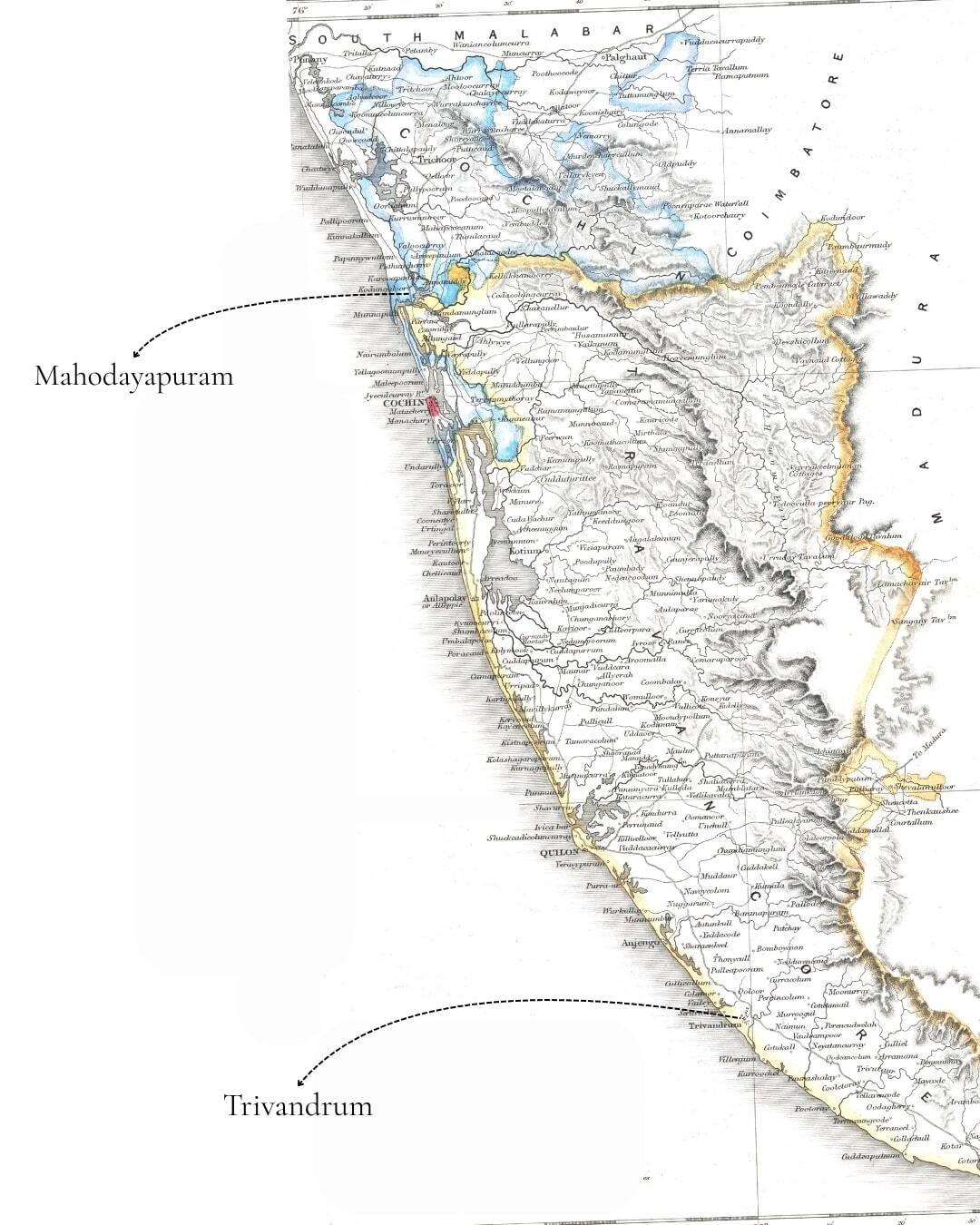
<p>It was to commemorate this legend that the later Cheras built a temple right across their palace at “Vanchi” — The capital for their ancient kingdom — at the supposed place where Nayanar prayed day and night to his lord. This was the city of Mahodayapuram. — now about 40 kilometres North of the bustling city of Kochi, in the outskirts of a small town called Kodungallur — the city that would go on to give the Cholas their most powerful of queens: Including Kokkilan Adigal, Queen to Parantaka Chola I—the Conqueror of Lanka and Madurai.</p>

<p>This now not-so-famous temple’s deity—Vanchinathan, Shiva as the Lord of the Vanchi—was once the great tutelary deity of the Cheras. This shrine would come to be the only one in the entirety of what is now Kerala, to be mentioned in ancient Tamil Sangam literature and the Thevaram hymns.</p>

<p>Centuries after the time of the Cheras, in the 1700s—at a time when the Dutch had started stepping into India’s western coast—would come the great king: Marthandavarma of Travancore. The man, who through his bloody rampages would consolidate the balcanised region into <em>his Travancore</em> — much to the South of the area the Cheras had ruled over. The same man who would, after all this, surrender himself, and his whole kingdom, to the deity he so loved: The Lord Padmanabha, at the great temple in Trivandrum.  Every ruler of Travancore after this would come to be known by the title of ‘Padmanabha dasa’ — the servant of the Lord. Travancore would unquestionably become a Hindu state with its principal deity being the “Padmanabha” form of Vishnu.</p>

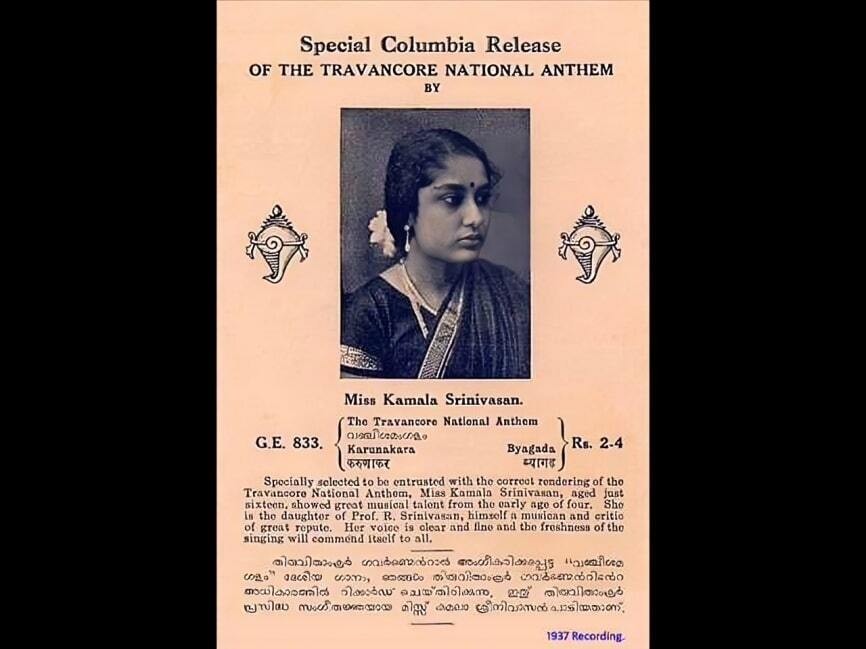
<p>Besides all this, during the 1930s—about 170 years after Marthandavarma—came a commission that was made to the then Court Poet, and the Chief Secretary at the court of Travancore—Ulloor S. Parameswara Iyer—to compose the first ever anthem for the Travancore state. His genius would give Travancore this very piece that you heard: a Shivite anthem for the Vaishnavite Deity’s Kingdom—an anthem that would come to be largely forgotten after the state’s accession into India.</p>

<p>The great anthem would come to become the formal closing piece for the Travancore Radio for another 20 years, being sung in all royal gatherings and ceremonies thereafter.</p>

<p><img src="/assets/images/poster.jpeg" alt="Anthem Poster" /></p>

<p>The anthem would soon die, with the consolidation of the “Hindoo Princely State of Travancore” into the Indian Union, solely leaving a piece for adaptation by Carnatic singers and a few in Malayali cinema. But the question still persists — why did the state with a principal Vaishnavite deity have a Shivite anthem, dedicated to a deity and a temple much beyond the boundaries of the state itself? Well, unfortunately, the answer is not very comprehensive or satisfactory (atleast out of what I found).</p>

<p><img src="/assets/images/Triv.jpeg" alt="Map of Travancore" /></p>

<p>One additional piece of information that links Travancore to the Cheras is the title held by the Travancore king himself. The full regnal name was as follows:</p>
<blockquote>
  <p>“Sree Padmanabhadasa Vanchi Paala [Personal Name] Varma Kulasekhara Perumal”</p>
</blockquote>

<p>The title is indeed very interesting for 2 specific reasons: The reference of “Kulasekhara” which is a direct reference to the claim of the Travancore king to their supposed Chera heritage for it was the name held by the Later Cheras; and the additional title as the “Vanchi Paala”, the protoector of Vanchi—linking the title directly to the ancient Chera capital.</p>

<p>For further historical understanding, a deep dive into Medieval history is a must. Most of what is now southern Kerala was ruled by the Ay dynasty until the medieval period. After the collapse of the Later Cheras around 1124 CE—in central Kerala—remnants of the Chera royal house moved south. Rama Kulasekhara, the last Chera king, established his capital at Kollam around 1100-1122 CE. One branch of the Chera family is said to have been sent south to deal with Pandyan invasions and merged with the Ay kingdom. This created the “Chera-Ay dynasty” that ruled “Venad” from the 12th century onwards. This dynasty hosted famous rulers including Sangramadhira Ravivarman Kulasekhara (1266-1314) — the man who raided the Cholas and the Pandyas, and then crowned himself as “Tribhuvana Chakravarti” (ruler of three kingdoms: Chera, Chola, and Pandya) at Kanchipuram in 1312; and the man from whom the title of “Padmanabhadasa” is believed to have originated from—much before the reign of Marthanda Varma.</p>

<p>When Marthanda Varma assumed control of Travancore through his bloody campaigns in the 1700s, he had started to make an attempt to legitimise his authority in the kingdom. This process, as mentioned before, included the move of surrendering the kingdom the the Lord, identifying himself to be a mere servant of god—as a consequence any criticism of the king would be an attack on Lord Padmanabha himself.</p>

<p>Further, when Marthanda Varma performed the Hiranyagharbha ritual—a process usually used to elevate one’s Varna—in the process of ceremonially crowning himself as the legitimate king, he is said to have claimed the “Chera Mudi” (Chera crown) during the ceremony: hence adopting the title of “Kulasekhara Perumal” formally as part of his title, a title that the royalty of Travancore would use to harken back to their Chera heritage. This is probably a link to why the Travancore royals commissioned the anthem as a link to their Chera heritage — probably again a move for political legitimacy?</p>

<p>This is in no way a complete piece. The history of this goes beyond much of the information that you can find in the internet. Any further research, as I realised, is in the political correspondence of the 1920s, including letters, speeches, among other things. The complete picture is something that will certainly require answers to the following (leaving this here, so that I can go search for more):</p>
<ol>
  <li>Why was the anthem commissioned in the first place—was it solely to keep up with the “trend” of all princely states having their own anthem, or were there other reasons that led to the need arising?</li>
  <li>How was the anthem commissioned to Ulloor? — Any correspondence between Ulloor and the Royals about any specifications?</li>
  <li>What symbols of Chera heritage did the Travancore Royal family flaunt other than the anthem itself? — for this wouldn’t be the sole symbol of legitimising Travancore’s heritage from the Cheras</li>
  <li>The entire story of the consolidation of Travancore — Marthanda Varma’s story: what were his actions to legitimise his kingdom to be Chera? —actions that would come to have ramifications on Travancore rulers centuries after him, hence leading to the anthem’s commissioning</li>
</ol>

<p>That’s pretty much where this piece ends. It all started with tracing the story of a song that has sort of become folk at this point—ultimately leading me to the story of the Cheras, the Ays, and Marthanda Varma, his campaigns, and his strategy for political legitimisation. A follow-up is certainly called for—it is something I will get back to when I have the necessary information.</p>

<p>Hope you liked this one :)</p>]]></content><author><name>Eshwar R A</name></author><category term="blog" /><category term="personal" /><summary type="html"><![CDATA[Travancore and the story of its Anthem]]></summary></entry><entry><title type="html">Stories Within History: Voice, Bias, and Perspective</title><link href="https://eshwarra.github.io/blog/personal/Historians-Hindsight-Hegemony/" rel="alternate" type="text/html" title="Stories Within History: Voice, Bias, and Perspective" /><published>2025-07-08T00:00:00+00:00</published><updated>2025-07-08T00:00:00+00:00</updated><id>https://eshwarra.github.io/blog/personal/Historians-Hindsight-Hegemony</id><content type="html" xml:base="https://eshwarra.github.io/blog/personal/Historians-Hindsight-Hegemony/"><![CDATA[<h1 id="introduction">Introduction</h1>

<p>My initial fling in “reading” started off with a few set of history books that were much different from the conventional ones—these were investigative material on certain subject: wherein the author would pick a topic, and makes their case for it—this instead of having much of a “story” to paint: but instead filled with several dramatically different timelines, and legal documents. For example, consider J Sai Deepak’s first book—it literally starts off with an abstract theoretical explanation of this rather new concept called “decoloniality”—which only became a thing in the 1990s, only to talk about the Reformation movement in Europe (16th century) in the next chapter, and then he uses that as the base to make his case for colonialism and colonial presumptions and biases that exist in subjects like International law—where he takes a 1940s timeline—and the formation of the UN Charter (all this in just 40 pages)—all this to jump back to the League of Nations and lawmaking in colonial India in his last chapter: The goal, for him, of this exercise was to make the case for there existing a continued colonial mindset in Indian thought, and the dire need to “decolonise” it. This is a continuum of writing style that I would call the “courtroom style argumentation”—something I see with many eminent authors like Arun Shourie, and Rajeev Malhotra: Where they present their case, then cite facts that support their case—and further also talk about facts that counter their case, with the sole intent of “debunking” or “exposing” them. Just a disclaimer—none of the authors I just mentioned claim to be “historians”: they very clearly simply use history as a tool to make their case in many instances: a case that is usually—if not always—political in nature.</p>

<p>What I truly respect about many of these authors is the fact that they do not hide under the garb of neutrality: they are fairly transparent about their views and the idea they want to present by the end of the book—however skewed such a view may be, is for the reader to judge. Or to put it in a sentence: their primary goal is to make their “case” for a particular narrative—with facts—and not to present a historical account, or contribute to historiography as an academic exercise.</p>

<p>Now, to our centre of attention for the rest of this blog—THE HISTORIANS. Historians tend to have style of writing that is fairly different and somewhat straightforward (in terms of the “timeline”): as they often claim, they “are tasked with looking at all the “facts” they have, and then paint the most complete picture they can from those very facts (whatever primary or non-primary sources)”. Although a good chunk of today’s history-based scholarship revolves around summarising the same existing facts—what real, and good historiography entails is taking on a subject, assessing the sources—especially the primary sources—and then attempting to reshape or add to an existing narrative: in turn ending up “contributing” to that existing or non-existing narrative.  Bar the extravagance in what I attempted to say in the previous sentence, for I will take up the entirety of the next section to explain the very same point: what—in my opinion—entails “good historiography”. This entire article is going to be about these very historians—Their style, method, and mainly: their inherent biases.</p>

<h1 id="the-task-of-the-historian">The Task of the Historian</h1>

<p>History is actually pretty fun, as nerdily poetic as it may sound—it is like solving a puzzle. Imagine this—you are trying to trace a particular story that transpired sometime long ago. For example’s sake, say you are tracing the story of the Mughal Emperor Akbar. There will be everything from <em>oral narratives</em> to <em>written sources</em>, <em>archaeological evidence</em>, among other things, that you will have to go through, and bridge together to paint the best story that you can from all this.</p>

<p>Now, taking our previous example, within the tomes of sources for you to consider in order to trace this story (literally out of the 100s of different sources you will have to read through), assume you only consider just 2 written sources. For the first source, let’s take the writings of someone in Akbar’s court—this man called “Abul Fazl”, who wrote flattering accounts of Akbar. To quote this man speaking of the Emperor, this is what he had to say:</p>
<blockquote>
  <p>“The King, who is the shadow of God, must be a fountain of justice and mercy.”</p>

  <p>“He is a second Solomon in wisdom, a second Alexander in bravery, and a second Anoshirwan in justice.”</p>
</blockquote>

<p>This was the godly impression you will find of Akbar, which was painted by Abul—a member of his court. Now, let us consider a second source—this man called “Abdul Qadir Badayuni”, who was very much critical of Akbar. To quote what Badayuni had to say about the Emperor:</p>
<blockquote>
  <p>“The Emperor made himself a God of the earth, and required men to prostrate before him.”</p>

  <p>“Instead of truth and wisdom, there was argument, hypocrisy, and disbelief.”</p>
</blockquote>

<p>This was what Badayuni had to say about Akbar, and his conduct in court—you see the contrast between both the writings about the very same man for yourself.</p>

<p>Now, put yourself in the shoes of a historian. Both these men whom I quoted have drastically different first-person accounts of one man: these are very literally “primary sources” conflicting with each other! So, how would you end up building your story of this emperor?</p>

<p>Now, in order to resolve the 2 conflicting sources, you start looking at all the other evidences—”What were the Europeans, who had just arrived, saying about Akbar?”, “What were the inscriptions saying about Akbar?”, “What was an ordinary peasant saying about Akbar at the time?”, “What were Akbar’s enemies (like rival kings) saying about him?”….</p>

<p>Once you put all these “pieces of the puzzle” together, you start getting a clearer picture of the man you are trying to flesh out. All this, to only come back at the end and admit that “Hey, despite putting all the effort to go through all this stuff, I was not there in that particular period to attest to what exactly happened—I will admit (despite my hard work) to the fact that this was not the exact account of his life, but it is the best I could do with all the work I put in!”</p>

<p>Let’s take a slightly different example—one of the Chola Empire that encompassed most of modern-day Tamil Nadu. You are trying to write a biography on one of the emperors, Rajaraja Chola I, a man who existed about 1000 years ago. Going back 1000 years, in the Tanjavur Big Temple (Brihadeeswara) inscription, he describes himself as follows:</p>
<blockquote>
  <p>“He who conquered the swirling sea with his sword; he whose arms were never weary in battle; the lion to the elephant of enemy kings; he who took the crowned heads of the eleven kings in the field of Koppam and made their wives widows before the moon could rise.”</p>
</blockquote>

<p>Barring the flamboyance, it actually becomes a rather scary task to trace history from such an ancient period. Like, think of it, your primary information on this period comes extensively from archaeology, but the “primary sources” which arise from this archaeology are themselves biased and go on to exaggerate this man. Further, unlike the Akbar court example, you have no court historians to give you different character portrayals of the man, you also don’t have any colonial accounts—for they hadn’t landed in the shores of this nation at the time, and I can go on and on of how much there is a comparative lack of evidence.</p>

<p>Hence, the job of a historian in this case becomes—again—to do their best in using the limited pieces of information to paint the best picture.</p>

<p>Let me give you a 3rd example—which also somewhat exposes a lot of current-day narratives which influence public discourse: hence also proving my point that “history is much more than an academic exercise—it shapes real-time narratives”. Colonial accounts are considered by many to be primary sources of history when it comes to tracing the dynamic from the 1500s to the 1700s: but let me show you how flawed these very colonial accounts can be—and how these flawed accounts continue to shape discourse today.</p>

<p>Take, for example, the practice of “Sati”: where a widow would immolate herself on her deceased husband’s funeral pyre—something that our history textbooks do speak of. Sati was over-exaggerated in colonial writings—this has been broadly acknowledged by historians today. Again, not denying that such a practice existed—just saying that the numbers of how widespread the practice was are rather heavily exaggerated.</p>

<p>To prove this, let’s consider the example of Bengal, where in 1830, James Peggs—an English missionary claimed “10,000 cases of Sati in a year”, but on the contrary, you have official colonial records from 1929 which speak of only 600-700 cases annually in the region. Historians like Andrea Major have argued that such numbers were inflated to justify British intervention as a “civilising mission”.</p>

<p>Further, you will find similar missionary accounts in the south too, where missionaries had then claimed to have witnessed similar cases of Sati in the South-Western Coast (what is now Kerala). But it is widely known of a fact, that Sati was not at all permissible in this region—apart from colonial records showing a total of “0” cases of Sati in this region, this region followed a matrilineal system, where the family’s “lineage” is traced through the mother’s side of the family: including inheritance of property among other things. In such a case, the practice of Sati would be senseless of a practice to follow, for if females were to immolate themselves on the pyre, the family line would cease to continue. Manu S Pillai records this very fact in his seminal work “The Ivory Throne”:</p>
<blockquote>
  <p>“In fact, in Kerala, there are stories of women being told, if they wanted to perform Sati, to cross the border and do it in British territory, not in the kingdom of Travancore.”</p>
</blockquote>

<p>The whole point I wanted to make in the example was that colonial records have often been biased against the native Indian populace and it’s practices—their stereotyping of Sati, and bias against “pagan”, and “heathen” indigenous practices are very much reflective in the language they use in their works, and yet, these colonial records are one of the only gateways we have into a huge section our past.</p>

<p>The works of these missionaries and other colonial historiographers is integral to us, and our current understanding of history, for they were the first to undertake translations of Hindu epics and texts into English and other European languages, document the traditions and practices of the people, and print and preserve such observations (by the introduction of the printing press), among other things. Basically, a lot of Indian history as we know it today is what we have derived from colonial records.</p>

<p>Yet as I showed, the authors of these records have their own inherent biases—so, being a historian, how would you differentiate fact from their exaggeration or misinterpretation? Basically, the question is: “When these colonial authors had their own biases and misunderstandings of India, how would you use their writings as a ‘reliable’ source of history?”</p>

<p>As you saw in the past 3 examples, historiography is a fairly difficult task. Many times, your primary sources can themselves be over-exaggerated, or contradictory to other primary sources, while your secondary sources—like colonial records—can be over-exaggerated or misinterpreted accounts of the happening. This is where the historian steps in—to accumulate all records, attempt to differentiate the sources, and paint the best possible picture.</p>

<h1 id="the-way-ahead">The Way Ahead</h1>

<p>History is always about “subjectivity”—oftentimes it is the writer’s bias that shapes the way they approach something. Often, when the same evidence and material are provided to 2 different historians, they may tend to write 2 drastically different interpretations of the very same stuff. For example, throughout the past—with history as a discipline—it was always men writing history. It was only a few decades ago that women also started writing history—this, in turn, also made men focus more on female figures, and the same stories from a female perspective. There was suddenly a counter to the “Heteronormative male gaze” of thinking history as all about “men, kings, and wars…”. The female accounts provided a different perspective, often to the very same stories. Take, for example, the Mughals: for a long time, our perspective of the Mughals was that of just a “bunch of kings that came after each other—some better than the other—until it all ended after Aurangazeb”.</p>

<p>If you come to think of it, it is a very male way of looking at all the 300-odd years of the Mughal Empire, as just a bunch of kings that came after each other. It was only recently that you had women write on the very same subject—take, for example, works like “Daughters of the Sun”, by Ira Muckoty, on the subject of the Mughals. In her book, she shows that—contrary to popular conception—the Mughal “<em>Begums</em>” were not just women lavishing in their palaces. She instead shows how instrumental these “begums” were in the Mughal court—from diplomatic missions, to authoring chronicles, to minting coins, to wielding significant economic and cultural influence: the begums were central to the Mughal court. You will see a similar trend of new perspectives emerge when you have women writing about other women—take, for example, Indira Gandhi’s biography by Katherine Frank, or J. Jayalalithaa’s biographies by Vaasanthi.</p>

<p>The entire point that I attempted to convey in the previous 2 paragraphs was, “the greater the <strong>diversity</strong> of people writing history, the <strong>more perspectives</strong> we start to see”. While I did take the example of women v. men writing history (a gender example), you can apply the very same example to a lot of other subjects: a few examples: “Hindus v. Muslims: how would each side—of historians—look at the material with regard to someone like Aurangazeb? Would their religious conditioning play into their perspectives as they look at the exact same material?”, or “Dalit v. non-Dalit: how would each side look at Ambedkar as a historical figure? Would the difference in conditioning affect their perspective when they read the very same material on the man?”.</p>

<p>Apart from the people writing history, there is also a difference in the way you can trace history—for example, apart from the age-old “men, kings, and wars” school, you can trace history through things like music, art, fabric, jewellery, and food, among other things.</p>

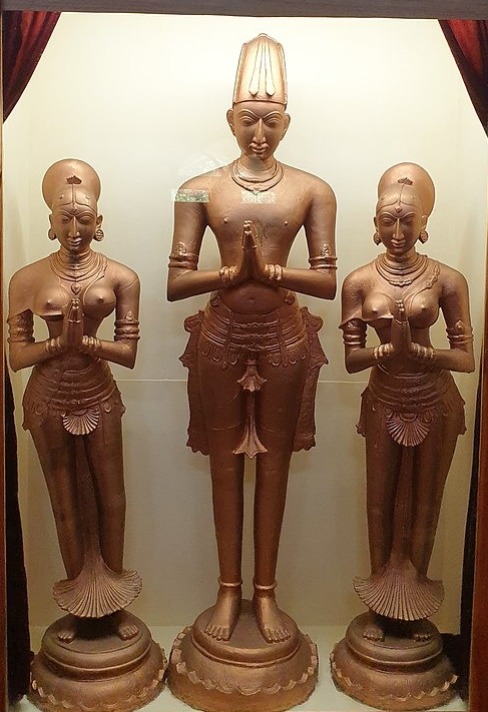
<p>With this, too, I shall give you a few examples—consider the great composer of Carnatic music, “Tyagaraja”. Within the 79 years he lived, he composed about 1000 songs—most of which were in Telugu. But, if you read about him, you will come to realise that he spent most of his life in what is now the state of Tamil Nadu—then why Telugu? Well, it was not just him, several other contemporaries of his time, who lived in the same region, including “Muttuswamy Diksitar”, who composed in Telugu whilst living in a mostly Tamil-speaking land. If you start to ask “why?”, you will soon come to realise that it was all thanks to the Vijaynagara Empire, which expanded into most of the south, making Telugu the official court language for a long time to come! Besides this, the Vijaynagara empire itself was greatly influenced by Persian culture at the time. A prime example of this would be Krishnadevaraya’s sculpture that he donated to the Tirumala temple during his reign. If you observe carefully, the hat that he is wearing in the sculpture, too, is not Indian—it is a Persian conical cap with 2 ribbons: in Telugu, it is referred to as the “Persianate kullayi”. Moreso, this influx of Persian culture—what now we would call “soft power”—had a bunch of ramifications: from adopting Persian administrative practices and titles, like using the title “sultan”, to incorporating Persian architectural elements like pointed arches and vaulted domes, to even adopting the Persian script for bureaucratic purposes.</p>

<p><img src="/assets/images/krishna.jpeg" alt="Sculpture of Krishnadevaraya and his wives at Chandragiri Museum, near Tirupati" /></p>

<p>Forgive me if I got lost a little in the story. It is just that, it is through these stories that I am trying to show you the number of different tangents you can draw—from music, to language, to culture and soft power: each of these are individual tangents historians have started to embark on barring the age old “men, kings, and wars” story-lines. Afterall, there is much more to history than a few men in power.</p>

<p>Decoloniality, too, is another aspect (I shall explain this in more detail in another piece, but I shall just try to summarize it all here). Decoloniality was coined by Peruvian sociologist Anibal Quijano—while there is no set definition, for it is a very broad term, I will try explaining it briefly. The theory goes as such—even after the colonisers left our land, the colonial mindset has persisted: in the way we think, speak and act. For example, even after almost 80 years of independence, most of us still speak in English—our education is English, so is the syllabus, among other things. Decoloniality, in the context of this example, would be revisiting questions like “Can we replace English, with languages native to our land?”, or “What changes can we make to our education system, that makes it more original to “us”?”. Similarly, in the context of history, earlier I had detailed on how colonial historiography and records have inherent colonial biases. The problem is—most of Indian historiography still relies heavily on these records, which often produces false conclusions. It is like a game of Chinese whisper—what happened was one thing, what the colonial historians documented was another, and then what the contemporaries read it as is totally different. If we look at the example of indigenous practices alone—the question becomes “Why do I need the colonial authors’ interpretation of something—a foreigner who doesn’t understand the culture—to learn about my history?”. The question is not limited to colonial authors alone. Take, for example, South Indian ancient history—the Bahmani Sultanate, the rebel sultanates it broke into, the Vijayanagara, etc. Richard Eaton, an American historian currently working as a professor of history at the University of Arizona, is someone who has extensively worked on this period. The problem today is that, when even an Indian historian picks up the very same subject of “Deccan history”, they are unable to approach the primary sources on their own—instead, they heavily rely on citing Richard Eaton. This is the issue! Why is it that an Indian author must refer to the works of an American scholar for working on Indian history? Do we not have enough material here? And hence, the need for “decoloniality”: the need to think original—everyone (the left and the right) might have a different definition for what it entails, but all of them broadly agree that it is a necessity in Indian historiography.</p>

<p>There are a bunch of other subjects that need to be addressed in detail—Indian archaeology; the coterie of “eminent historians” who created their own elitist circles by citing each other’s works and thereby excluding anyone who didn’t subscribe to their views; a more detailed discussion on decoloniality; the Indian government and its neglect of history—all these are topics I wish to cover sometime in the future.</p>

<p>Nevertheless, I hope this very article was a good starter for you, the reader, to understand the nuances to historiography.</p>

<p>STAY TUNED for further articles, and THANK YOU for reading.</p>

<p>Do leave a text or a comment if you liked my work—it would mean a lot :)</p>]]></content><author><name>Eshwar R A</name></author><category term="blog" /><category term="personal" /><summary type="html"><![CDATA[All about Indian Historiography—the 'ideal history', and tracing the origins of 'bias']]></summary></entry><entry><title type="html">About Me and My Blog</title><link href="https://eshwarra.github.io/blog/personal/Introductory-piece/" rel="alternate" type="text/html" title="About Me and My Blog" /><published>2025-07-06T00:00:00+00:00</published><updated>2025-07-06T00:00:00+00:00</updated><id>https://eshwarra.github.io/blog/personal/Introductory-piece</id><content type="html" xml:base="https://eshwarra.github.io/blog/personal/Introductory-piece/"><![CDATA[<p>It was about 6 years ago, when I had just gotten into grade IX, that I made a new friend in the school bus called “Adithya”. This man—who was a senior of mine—is someone I will forever cherish for building in me an interest for a lot of what I do now as a “grown up”. Every evening, as I would sit in the school bus—a place where I would otherwise just doze off till my stop would come—after a tiresome day, this was the man who constantly kept me awake: a knowledgable soul who would rant to me from everything about tech, to polity to history. Only little did I know then of how much those “rants” would come to influence the then “introverted” Eshwar.</p>

<p>It was about 6 months from that day that “introverted” Eshwar would go on to attend his first Model UN Conference—the first exposure this kid would have to others of his age: speaking and listening to them on topics he so dearly loved.</p>

<p>As poetically overexaggerated as it sounded until now, this kid grew up to be me: a semi-grown-up dude who still loves to do the very same “MUN” stuff: stuff that many have called me “amateur” and “childish” for.</p>

<p>You see, I joined engineering (I am a 3rd year student now)—barring the stereotyping, it is a field I actually do very much enjoy studying and working with. Nevertheless, it is—I am sorry to say this—not at all a place where I can in any way nurture my love and interest for fields like polity and history: hence, as I realised very recently, I ended up finding solace in things like debates, and MUNs: places where my love for these subjects in one way or the other persists in staying alive.</p>

<p>This blog, which is just an attempt at something new, is something I hope plays out as a better exercise, and a place to nurture the very same interests of mine.</p>

<p>A completely parallel timeline—I was never a reader as a kid: I still joke around with friends about how I tried reading the first Harry Potter book, and after reading about the first 15 pages, ended up just binging on all the movies (for I did not have the patience to sit through months of reading to only get the same plot in a few hours of movie binging). As much as I hate to say it, my disdain for fiction-based books has persisted ever since: honestly, it was the conception of books in general that I ever so hated.</p>

<p>Given the disdain for books in general, I never put in a huge effort to “read” about the subjects “I so dearly loved”—a lot of my “absorbing” hence was literally from YouTube videos and podcasts for about a good few years. Speaking of YouTube, for about 2 years i.e. 2022 and 2023, my algorithm gave to me a person who inspired me for much of the time to come. Now that I come to think of it, it is a man, whom I have come to ideologically disagree with on many aspects, yet owe a lot to for nurturing my interest in certain subjects I would have otherwise never delved into—J Sai Deepak. While some might call him a “Hindutva fascist” (I won’t go into that debate), his lectures (not the half-hour TV debates that are constantly put on YouTube reels which give him super-natural laser eyes) on matters like Kashmir and Article 370, and most importantly his scholarship i.e. his 2 books—stuff I still believe are underrated for they are heavily masked by his public identity and debate appearances—have had a phenomenal impact on me as a student of these subjects.</p>

<p>Further, the works of authors like Arun Shourie, Manu S Pillai, Rajiv Malhotra, Vikram Sampath, and Richard Eaton—people who are broadly painted as both “left” and “right” winged—have helped me shape much more nuanced views of polity, and history alike over a period of 3 years.</p>

<p>Coming back to me: the concept of a blog is something I felt—for over a year—is something that I really need to begin for myself. I genuinely don’t know, or expect this exercise in any way to attract readers or benefit anyone—this is a space where I just want to put my work out—at my own pace— whether anyone wants to read it or not. The days ahead for me shall definitely be tough—I have my college starting in about a month, and subsequently my “final year” project among other things: I don’t envision myself being clocked regular to this blog i.e. the gap between each post may be either a week, or a few months—but never will it (by gods’ willing) “stop” as an exercise. This blog—as I envision it— is just a space where I want to post when I “get the mood” for writing something—a “mood” I get fairly often these days.</p>

<p>Basically, I have no hope of this being a “successful” exercise. If anything, it is an attempt—an attempt to catalogue (or put somewhere) my thoughts, my limited knowledge, and stuff that I enjoy learning about: an attempt that shall not stop; something that “introverted” little Eshwar would be happy to see his older self do.</p>

<p>Now (barring this narcissistic rant I just gave), coming to what it is that I plan on putting here—well, there are a bunch of ideas that I have going ahead. While my blogs shall occasionally talk about tech, and current day polity, the main goal of this blog is to talk about history—not history as an academic exercise, but historiography as a “myth busting” tool to allow to draw into the present. History is an imperative in any discussion in today’s day—no political discussion today is free from the so-called “academic exercise” of history and the narratives that surround it: in the next post I shall detail on these ideas specifically—so do STAY TUNED.</p>]]></content><author><name>Eshwar R A</name></author><category term="blog" /><category term="personal" /><summary type="html"><![CDATA[An Introductory post—why the blog, the journey, and what I plan on doing]]></summary></entry></feed>