Stories Within History: Voice, Bias, and Perspective
Introduction
My initial fling in “reading” started off with a few set of history books that were much different from the conventional ones—these were investigative material on certain subject: wherein the author would pick a topic, and makes their case for it—this instead of having much of a “story” to paint: but instead filled with several dramatically different timelines, and legal documents. For example, consider J Sai Deepak’s first book—it literally starts off with an abstract theoretical explanation of this rather new concept called “decoloniality”—which only became a thing in the 1990s, only to talk about the Reformation movement in Europe (16th century) in the next chapter, and then he uses that as the base to make his case for colonialism and colonial presumptions and biases that exist in subjects like International law—where he takes a 1940s timeline—and the formation of the UN Charter (all this in just 40 pages)—all this to jump back to the League of Nations and lawmaking in colonial India in his last chapter: The goal, for him, of this exercise was to make the case for there existing a continued colonial mindset in Indian thought, and the dire need to “decolonise” it. This is a continuum of writing style that I would call the “courtroom style argumentation”—something I see with many eminent authors like Arun Shourie, and Rajeev Malhotra: Where they present their case, then cite facts that support their case—and further also talk about facts that counter their case, with the sole intent of “debunking” or “exposing” them. Just a disclaimer—none of the authors I just mentioned claim to be “historians”: they very clearly simply use history as a tool to make their case in many instances: a case that is usually—if not always—political in nature.
What I truly respect about many of these authors is the fact that they do not hide under the garb of neutrality: they are fairly transparent about their views and the idea they want to present by the end of the book—however skewed such a view may be, is for the reader to judge. Or to put it in a sentence: their primary goal is to make their “case” for a particular narrative—with facts—and not to present a historical account, or contribute to historiography as an academic exercise.
Now, to our centre of attention for the rest of this blog—THE HISTORIANS. Historians tend to have style of writing that is fairly different and somewhat straightforward (in terms of the “timeline”): as they often claim, they “are tasked with looking at all the “facts” they have, and then paint the most complete picture they can from those very facts (whatever primary or non-primary sources)”. Although a good chunk of today’s history-based scholarship revolves around summarising the same existing facts—what real, and good historiography entails is taking on a subject, assessing the sources—especially the primary sources—and then attempting to reshape or add to an existing narrative: in turn ending up “contributing” to that existing or non-existing narrative. Bar the extravagance in what I attempted to say in the previous sentence, for I will take up the entirety of the next section to explain the very same point: what—in my opinion—entails “good historiography”. This entire article is going to be about these very historians—Their style, method, and mainly: their inherent biases.
The Task of the Historian
History is actually pretty fun, as nerdily poetic as it may sound—it is like solving a puzzle. Imagine this—you are trying to trace a particular story that transpired sometime long ago. For example’s sake, say you are tracing the story of the Mughal Emperor Akbar. There will be everything from oral narratives to written sources, archaeological evidence, among other things, that you will have to go through, and bridge together to paint the best story that you can from all this.
Now, taking our previous example, within the tomes of sources for you to consider in order to trace this story (literally out of the 100s of different sources you will have to read through), assume you only consider just 2 written sources. For the first source, let’s take the writings of someone in Akbar’s court—this man called “Abul Fazl”, who wrote flattering accounts of Akbar. To quote this man speaking of the Emperor, this is what he had to say:
“The King, who is the shadow of God, must be a fountain of justice and mercy.”
“He is a second Solomon in wisdom, a second Alexander in bravery, and a second Anoshirwan in justice.”
This was the godly impression you will find of Akbar, which was painted by Abul—a member of his court. Now, let us consider a second source—this man called “Abdul Qadir Badayuni”, who was very much critical of Akbar. To quote what Badayuni had to say about the Emperor:
“The Emperor made himself a God of the earth, and required men to prostrate before him.”
“Instead of truth and wisdom, there was argument, hypocrisy, and disbelief.”
This was what Badayuni had to say about Akbar, and his conduct in court—you see the contrast between both the writings about the very same man for yourself.
Now, put yourself in the shoes of a historian. Both these men whom I quoted have drastically different first-person accounts of one man: these are very literally “primary sources” conflicting with each other! So, how would you end up building your story of this emperor?
Now, in order to resolve the 2 conflicting sources, you start looking at all the other evidences—”What were the Europeans, who had just arrived, saying about Akbar?”, “What were the inscriptions saying about Akbar?”, “What was an ordinary peasant saying about Akbar at the time?”, “What were Akbar’s enemies (like rival kings) saying about him?”….
Once you put all these “pieces of the puzzle” together, you start getting a clearer picture of the man you are trying to flesh out. All this, to only come back at the end and admit that “Hey, despite putting all the effort to go through all this stuff, I was not there in that particular period to attest to what exactly happened—I will admit (despite my hard work) to the fact that this was not the exact account of his life, but it is the best I could do with all the work I put in!”
Let’s take a slightly different example—one of the Chola Empire that encompassed most of modern-day Tamil Nadu. You are trying to write a biography on one of the emperors, Rajaraja Chola I, a man who existed about 1000 years ago. Going back 1000 years, in the Tanjavur Big Temple (Brihadeeswara) inscription, he describes himself as follows:
“He who conquered the swirling sea with his sword; he whose arms were never weary in battle; the lion to the elephant of enemy kings; he who took the crowned heads of the eleven kings in the field of Koppam and made their wives widows before the moon could rise.”
Barring the flamboyance, it actually becomes a rather scary task to trace history from such an ancient period. Like, think of it, your primary information on this period comes extensively from archaeology, but the “primary sources” which arise from this archaeology are themselves biased and go on to exaggerate this man. Further, unlike the Akbar court example, you have no court historians to give you different character portrayals of the man, you also don’t have any colonial accounts—for they hadn’t landed in the shores of this nation at the time, and I can go on and on of how much there is a comparative lack of evidence.
Hence, the job of a historian in this case becomes—again—to do their best in using the limited pieces of information to paint the best picture.
Let me give you a 3rd example—which also somewhat exposes a lot of current-day narratives which influence public discourse: hence also proving my point that “history is much more than an academic exercise—it shapes real-time narratives”. Colonial accounts are considered by many to be primary sources of history when it comes to tracing the dynamic from the 1500s to the 1700s: but let me show you how flawed these very colonial accounts can be—and how these flawed accounts continue to shape discourse today.
Take, for example, the practice of “Sati”: where a widow would immolate herself on her deceased husband’s funeral pyre—something that our history textbooks do speak of. Sati was over-exaggerated in colonial writings—this has been broadly acknowledged by historians today. Again, not denying that such a practice existed—just saying that the numbers of how widespread the practice was are rather heavily exaggerated.
To prove this, let’s consider the example of Bengal, where in 1830, James Peggs—an English missionary claimed “10,000 cases of Sati in a year”, but on the contrary, you have official colonial records from 1929 which speak of only 600-700 cases annually in the region. Historians like Andrea Major have argued that such numbers were inflated to justify British intervention as a “civilising mission”.
Further, you will find similar missionary accounts in the south too, where missionaries had then claimed to have witnessed similar cases of Sati in the South-Western Coast (what is now Kerala). But it is widely known of a fact, that Sati was not at all permissible in this region—apart from colonial records showing a total of “0” cases of Sati in this region, this region followed a matrilineal system, where the family’s “lineage” is traced through the mother’s side of the family: including inheritance of property among other things. In such a case, the practice of Sati would be senseless of a practice to follow, for if females were to immolate themselves on the pyre, the family line would cease to continue. Manu S Pillai records this very fact in his seminal work “The Ivory Throne”:
“In fact, in Kerala, there are stories of women being told, if they wanted to perform Sati, to cross the border and do it in British territory, not in the kingdom of Travancore.”
The whole point I wanted to make in the example was that colonial records have often been biased against the native Indian populace and it’s practices—their stereotyping of Sati, and bias against “pagan”, and “heathen” indigenous practices are very much reflective in the language they use in their works, and yet, these colonial records are one of the only gateways we have into a huge section our past.
The works of these missionaries and other colonial historiographers is integral to us, and our current understanding of history, for they were the first to undertake translations of Hindu epics and texts into English and other European languages, document the traditions and practices of the people, and print and preserve such observations (by the introduction of the printing press), among other things. Basically, a lot of Indian history as we know it today is what we have derived from colonial records.
Yet as I showed, the authors of these records have their own inherent biases—so, being a historian, how would you differentiate fact from their exaggeration or misinterpretation? Basically, the question is: “When these colonial authors had their own biases and misunderstandings of India, how would you use their writings as a ‘reliable’ source of history?”
As you saw in the past 3 examples, historiography is a fairly difficult task. Many times, your primary sources can themselves be over-exaggerated, or contradictory to other primary sources, while your secondary sources—like colonial records—can be over-exaggerated or misinterpreted accounts of the happening. This is where the historian steps in—to accumulate all records, attempt to differentiate the sources, and paint the best possible picture.
The Way Ahead
History is always about “subjectivity”—oftentimes it is the writer’s bias that shapes the way they approach something. Often, when the same evidence and material are provided to 2 different historians, they may tend to write 2 drastically different interpretations of the very same stuff. For example, throughout the past—with history as a discipline—it was always men writing history. It was only a few decades ago that women also started writing history—this, in turn, also made men focus more on female figures, and the same stories from a female perspective. There was suddenly a counter to the “Heteronormative male gaze” of thinking history as all about “men, kings, and wars…”. The female accounts provided a different perspective, often to the very same stories. Take, for example, the Mughals: for a long time, our perspective of the Mughals was that of just a “bunch of kings that came after each other—some better than the other—until it all ended after Aurangazeb”.
If you come to think of it, it is a very male way of looking at all the 300-odd years of the Mughal Empire, as just a bunch of kings that came after each other. It was only recently that you had women write on the very same subject—take, for example, works like “Daughters of the Sun”, by Ira Muckoty, on the subject of the Mughals. In her book, she shows that—contrary to popular conception—the Mughal “Begums” were not just women lavishing in their palaces. She instead shows how instrumental these “begums” were in the Mughal court—from diplomatic missions, to authoring chronicles, to minting coins, to wielding significant economic and cultural influence: the begums were central to the Mughal court. You will see a similar trend of new perspectives emerge when you have women writing about other women—take, for example, Indira Gandhi’s biography by Katherine Frank, or J. Jayalalithaa’s biographies by Vaasanthi.
The entire point that I attempted to convey in the previous 2 paragraphs was, “the greater the diversity of people writing history, the more perspectives we start to see”. While I did take the example of women v. men writing history (a gender example), you can apply the very same example to a lot of other subjects: a few examples: “Hindus v. Muslims: how would each side—of historians—look at the material with regard to someone like Aurangazeb? Would their religious conditioning play into their perspectives as they look at the exact same material?”, or “Dalit v. non-Dalit: how would each side look at Ambedkar as a historical figure? Would the difference in conditioning affect their perspective when they read the very same material on the man?”.
Apart from the people writing history, there is also a difference in the way you can trace history—for example, apart from the age-old “men, kings, and wars” school, you can trace history through things like music, art, fabric, jewellery, and food, among other things.
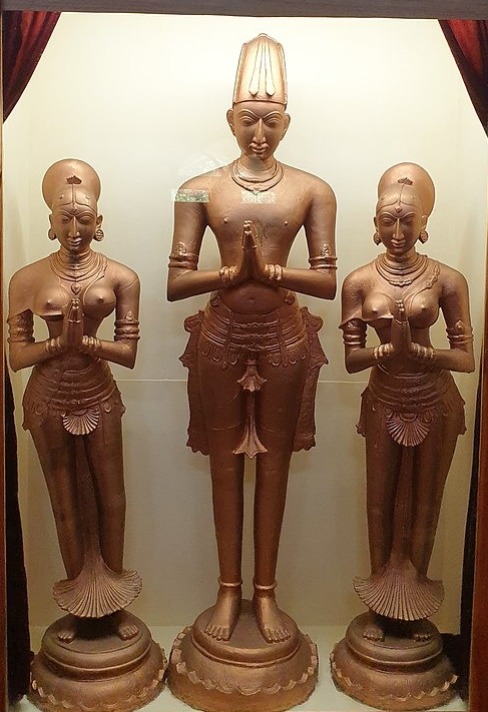
With this, too, I shall give you a few examples—consider the great composer of Carnatic music, “Tyagaraja”. Within the 79 years he lived, he composed about 1000 songs—most of which were in Telugu. But, if you read about him, you will come to realise that he spent most of his life in what is now the state of Tamil Nadu—then why Telugu? Well, it was not just him, several other contemporaries of his time, who lived in the same region, including “Muttuswamy Diksitar”, who composed in Telugu whilst living in a mostly Tamil-speaking land. If you start to ask “why?”, you will soon come to realise that it was all thanks to the Vijaynagara Empire, which expanded into most of the south, making Telugu the official court language for a long time to come! Besides this, the Vijaynagara empire itself was greatly influenced by Persian culture at the time. A prime example of this would be Krishnadevaraya’s sculpture that he donated to the Tirumala temple during his reign. If you observe carefully, the hat that he is wearing in the sculpture, too, is not Indian—it is a Persian conical cap with 2 ribbons: in Telugu, it is referred to as the “Persianate kullayi”. Moreso, this influx of Persian culture—what now we would call “soft power”—had a bunch of ramifications: from adopting Persian administrative practices and titles, like using the title “sultan”, to incorporating Persian architectural elements like pointed arches and vaulted domes, to even adopting the Persian script for bureaucratic purposes.
Forgive me if I got lost a little in the story. It is just that, it is through these stories that I am trying to show you the number of different tangents you can draw—from music, to language, to culture and soft power: each of these are individual tangents historians have started to embark on barring the age old “men, kings, and wars” story-lines. Afterall, there is much more to history than a few men in power.
Decoloniality, too, is another aspect (I shall explain this in more detail in another piece, but I shall just try to summarize it all here). Decoloniality was coined by Peruvian sociologist Anibal Quijano—while there is no set definition, for it is a very broad term, I will try explaining it briefly. The theory goes as such—even after the colonisers left our land, the colonial mindset has persisted: in the way we think, speak and act. For example, even after almost 80 years of independence, most of us still speak in English—our education is English, so is the syllabus, among other things. Decoloniality, in the context of this example, would be revisiting questions like “Can we replace English, with languages native to our land?”, or “What changes can we make to our education system, that makes it more original to “us”?”. Similarly, in the context of history, earlier I had detailed on how colonial historiography and records have inherent colonial biases. The problem is—most of Indian historiography still relies heavily on these records, which often produces false conclusions. It is like a game of Chinese whisper—what happened was one thing, what the colonial historians documented was another, and then what the contemporaries read it as is totally different. If we look at the example of indigenous practices alone—the question becomes “Why do I need the colonial authors’ interpretation of something—a foreigner who doesn’t understand the culture—to learn about my history?”. The question is not limited to colonial authors alone. Take, for example, South Indian ancient history—the Bahmani Sultanate, the rebel sultanates it broke into, the Vijayanagara, etc. Richard Eaton, an American historian currently working as a professor of history at the University of Arizona, is someone who has extensively worked on this period. The problem today is that, when even an Indian historian picks up the very same subject of “Deccan history”, they are unable to approach the primary sources on their own—instead, they heavily rely on citing Richard Eaton. This is the issue! Why is it that an Indian author must refer to the works of an American scholar for working on Indian history? Do we not have enough material here? And hence, the need for “decoloniality”: the need to think original—everyone (the left and the right) might have a different definition for what it entails, but all of them broadly agree that it is a necessity in Indian historiography.
There are a bunch of other subjects that need to be addressed in detail—Indian archaeology; the coterie of “eminent historians” who created their own elitist circles by citing each other’s works and thereby excluding anyone who didn’t subscribe to their views; a more detailed discussion on decoloniality; the Indian government and its neglect of history—all these are topics I wish to cover sometime in the future.
Nevertheless, I hope this very article was a good starter for you, the reader, to understand the nuances to historiography.
STAY TUNED for further articles, and THANK YOU for reading.
Do leave a text or a comment if you liked my work—it would mean a lot :)